
The operator's liability in the case of an incident is limited to 3,000 crore for reactors with thermal power above 3,600 Megawatt; 1,500 crore for reactors with thermal power between 1,500 Mw and 3,600 Mw; 750 crore for reactors with thermal power between 750 Mw and 1,500 Mw; 300 crore for reactors with thermal power between 150 Mw and 750 Mw; and 100 crore for reactors having thermal power up to 150 Mw, fuel cycle facilities other than spent fuel reprocessing plants and transportation of nuclear materials.

The Indian government has introduced a bill to overhaul the civil nuclear sector, allowing private participation and establishing a new liability regime. The SHANTI Bill, 2025, aims to repeal existing acts and address industry concerns.

In the second part of a three-part series, Manoj Kumar and Lydia Powell, in an Observer Research Foundation study, discuss at length the various loopholes in the Nuclear Liability Bill, whose amended version was recently passed by the Lok Sabha.
Greenpeace has also launched a petition addressed to Prime Minister Manmohan Singh, which the organisation claims has been signed by over 21,000 people.
While the cap on liability is lower than in several other countries, few producers, including those in India, will supply nuclear power equipment without such a bill -- raising the caps is an obvious solution.
The Bill is likely to pave the way for amending two existing legislations -- the Atomic Energy Act 1962, and the Civil Liability for Nuclear Damage Act 2010.
Ending months of wrangling between treasury benches and the opposition, the Lok Sabha on Wednesday passed the civil nuclear liability bill after government dropped the contentious provision of 'intent' in the case of accident adopting a Bharatiya Janata Party amendment, paving the way for nuclear commerce with the world.
The Parliamentary Standing Committee on Science and Technology, which has held marathon deliberations on the controversial Civil Liability for Nuclear Damage Bill 2010, is expected to present its report to Parliament on August 9.
The Bharatiya Janata Party and the Left parties have already indicated opposition to the Civil Liability for Nuclear Damage Bill that is key to operationalise the landmark Indo-US nuclear deal. The Bill pegs the maximum amount of liability in case of each nuclear accident at Rs 300 crore to be paid by the operator of the nuclear plant.
Paving the way for India to have nuclear commerce with the world, Parliament on Monday adopted a nuclear liability bill with the government insisting that the compensation package for victims matches that of the United States and it was still open to accommodate some suggestions.
What is in store for the Koodankulam nuclear power plants, asks S P Udayakumar.
The passage of the Women's Reservation Bill in the Rajya Sabha on Tuesday has not ended the problems of the United Progressive Alliance (UPA).
Chairman of Parliamentary Standing Committee on Science and Technology T Subbirami Reddy on Friday voiced confidence that the report on the nuclear liability bill will be tabled in Parliament on Wednesday, despite differences among members.
The passing of the nuclear liability bill will be a political and diplomatic victory for Prime Minister Manmohan Singh at a time when he is being seen as getting weaker and his government is drifting on all major national challenges like price rise, Kashmir and Naxalism.
Getting the requisite numbers to pass the Civil Liability for Nuclear Damage Bill 2010 in the Lok Sabha may be the least of the United Progressive Alliance's problems. Lawyers and legal experts, including those who support the legislation, say there are many instances of poor drafting and anomalies that have the potential to generate more controversy if the Bill is passed in its current form.
India Inc on Tuesday expressed deep reservations over the supplier liability provision -- the contentious Clause 17(b) -- in the Civil Liability for Nuclear Damages Bill, 2010, saying it would seriously hinder nuclear commerce.
Gopal Krishna makes a case against the nuclear liability bill.
Facing stiff opposition over the Nuclear Liability Bill, the government on Friday said it will consult all political parties before tabling the draft legislation in Parliament. "
As a Parliamentary panel races to submit its report on the nuclear liability bill, Bharatiya Janata Party appears to have dug its heels asking the government to clarify whether the draft legislation was India-specific or being enacted to fulfil requirements of international treaties.
The Parliamentary panel examining the controversial nuclear liability bill is expected to finalise its report in time for introduction of the draft legislation during the monsoon session beginning July 26. The Parliamentary Standing Committee on Science and Technology, Environment on Forests is examining the Civil Liability for Nuclear Damage Bill, 2010 that was introduced in the Lok Sabha on May 7 amid stiff resistance from a united Opposition.
If a public sector company willfully enters into an agreement with a foreign vendor and abdicates its right to recourse which otherwise provides for its benefit, it would not only be violating the provisions of the Civil Liability for Nuclear Damages Act but also section 13(1)(d) of the Prevention of Corruption Act, notes Leader of Opposition in Rajya Sabha Arun Jaitley
"What is the need for such a legislation if the public sector and the government will be the only nuclear operators? What is the purpose of this law or of putting a cap on compensation if it is the government which has to pay?" a senior BJP MP said.The BJP fears that once this Bill is passed the government may allow private players later by effecting an amendment only regarding entry of private operators while leaving the Rs 500 crore compensation cap intact.
Pitching for enactment of a law to fix civil damages caused by nuclear accidents, Atomic Energy Commission Chairman Srikumar Banerjee said neither the Indian Environmental Protection Public Liability Insurance Act, 1991, nor the Indian Atomic Energy Act had provisions for damages caused due to war or radioactivity.
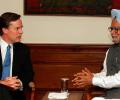
The India-US nuclear deal was aimed at ending India's nuclear isolation and nuclear apartheid, recalls Rup Narayan Das.
United States Ambassador to India Timothy J Roemer on Monday called on Bharatiya Janata Party president Nitin Gadkari and is understood to have discussed the nuclear liability bill, which is being opposed by the party. Sources said Roemer called on Gadkari to discuss the Civil Liability for Nuclear Damage Bill and allay apprehensions expressed by the BJP about the proposed legislation. BJP is opposing the Bill.

Bharatiya Janata Party General Secretary Arun Jaitley talks to Aditi Phadnis about the party's differences with the government
The Civil Nuclear Liability Bill is likely to come up for consideration in Parliament on Wednesday

Although the credit for acquiring the technological skill must be given to India's outstanding nuclear scientists, the decision to go nuclear was a political one that entailed clarity of vision, courage and resolve, points out Rup Narayan Das.

While the capital spending is being maintained at 3.1 per cent of the GDP, a little more would have boosted economic growth even further, suggests Rajiv Memani.

The reality is that far from being friendless, India is better positioned in the world than at any point post-Cold War, asserts Shekhar Gupta.
'Reviving the nuclear deal was crucial before the Obama visit... It was time for the BJP to admit that it was wrong, and redo the civil nuclear liability laws.'
